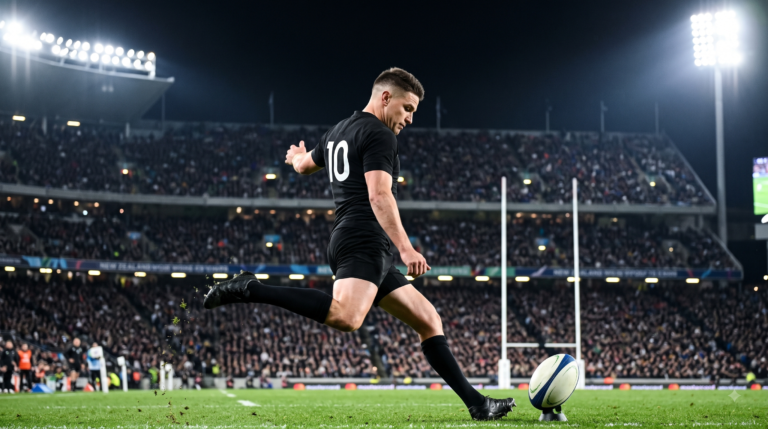
Juan Martin Hernandez: Argentina’s Greatest Fly-Half
Juan Martin Hernandez is the greatest fly-half Argentina has ever produced — and in his prime, between 2007 and 2010, there is a serious argument that Juan Martin Hernandez was the best number ten in the world. Not the second best. The best. Better than Jonny Wilkinson. Level with, or ahead of, Dan Carter. The nickname said it all: El Mago. The Magician. And those who watched him at his peak know the label was not hyperbole.
Born into Sport — The Juan Martin Hernandez Family
Juan Martin Hernandez was born on 7 August 1982 in Buenos Aires into one of Argentine sport’s most remarkable families. His uncle Patricio Hernández was part of the Argentine football squad at the 1982 FIFA World Cup. His sisters followed their own elite paths: Maripi Hernández became an Olympic medallist and world champion in field hockey, still playing top-division hockey well into her forties. Sport was not a choice in this family — it was the air they breathed.
Rugby found Juan Martin Hernandez through the amateur club Deportiva Francesa in Buenos Aires, where the French influence that would define much of his career was already present. He was tall — 1.87m — with hands that seemed to operate independently of the laws of physics, and a left boot of rare precision and imagination. He was not a player who fit a system. He was the kind of player systems were built around.
Stade Français and the Making of El Mago
In 2003, aged 21, Juan Martin Hernandez moved to Paris to join Stade Français. It was the beginning of a French chapter that would last most of his professional life. In six seasons at the club — 123 appearances, 581 points scored — he won the Top 14 championship in 2004 and 2007, and in 2007 became the first foreigner ever to be elected best player of the French championship. That award, voted by peers and coaches across the league, was a statement: the French knew what they had.
At Stade Français he also found his perfect half-back partner. Agustín Pichot — Argentina’s greatest scrum-half — was his club teammate. The two played together week after week in the Top 14, building a rhythm and understanding that would eventually be transplanted onto the world stage with devastating effect.
Rugby World Cup 2007 — The Definitive Performance
The 2007 Rugby World Cup in France was the tournament that changed everything for Argentina rugby — and Juan Martin Hernandez was its central figure. Moved to fly-half on the eve of the competition, he formed a half-back axis with Pichot and an inside-centre partnership with Felipe Contepomi that became the spine of one of the great World Cup campaigns.
The opening night. France vs Argentina in Paris. The hosts expected to win. Juan Martin Hernandez had other ideas. Argentina won 17-12 in a performance that shocked the rugby world and announced Los Pumas as genuine contenders. Then came the pool decider against Ireland — he kicked three drop goals in a single match. Three. Against Ireland, a team built on defensive pressure and set-piece dominance. Then a drop goal against Scotland in the quarter-final as Argentina advanced to the semi-finals for the first — and still only — time in their history.
They were eventually beaten by a superb South Africa side in the semi-final, then beat France again — in France — to claim the bronze medal. It remains the greatest result in Argentine rugby history. Juan Martin Hernandez was nominated by World Rugby for the International Player of the Year award. He finished the tournament as one of the most talked-about players on the planet.
The Drop Goal — With Either Foot
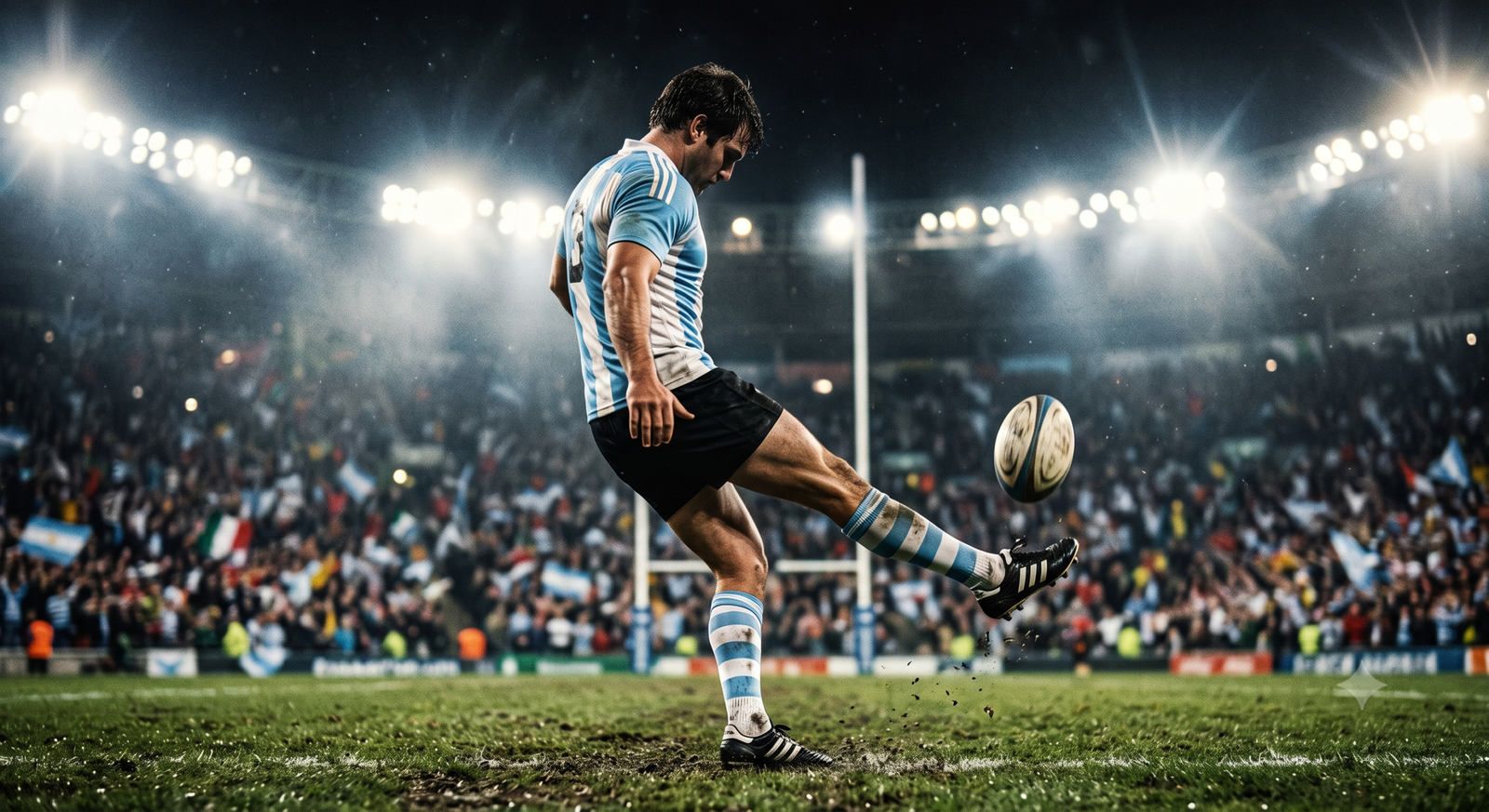
One detail separates Juan Martin Hernandez from every other fly-half of his generation: he could drop-kick with both feet. Left foot. Right foot. Under pressure, from distance, in the dying minutes of a World Cup match. The drop goal is already one of the hardest skills in rugby — executed well, it requires technique, nerve, timing, and a teammate willing to commit to the carry that creates the half-second of space you need. Hernandez could do it off either boot, which made him genuinely undefendable in certain moments.
The three drop goals against Ireland in the 2007 pool match are the most cited example — but the detail that gets lost is that not all of them came off his natural left foot. Hernandez read the defensive alignment, identified which foot gave him the better angle, and executed. No hesitation. That ambidexterity was not a trick. It was a weapon that he had trained deliberately, and it made him one of the most dangerous players alive in the final quarter of a close match. Dan Carter was extraordinary. Jonny Wilkinson was precise. But neither of them did it off both feet with the same confidence.
Was Juan Martin Hernandez Better Than Dan Carter?
The honest answer: in a short window — roughly 2007 to 2009 — yes, he was. Not over a career. Carter’s longevity, consistency, and volume of performance across fifteen years of All Blacks rugby makes him the canonical greatest fly-half in history. But Carter had an injury-blighted 2007 World Cup, while Juan Martin Hernandez had the tournament of his life. In those specific months, El Mago was the best ten on the planet.
The pundit Stephen Jones, writing in The Times, controversially ranked Juan Martin Hernandez as the second-best fly-half of all time — ahead of Wilkinson, ahead of Carter. That ranking provoked debate, as it was designed to. But the underlying point was serious: for a period, Hernandez was doing things with a rugby ball that nobody else on earth could do. The offloads in traffic. The drop goals under pressure. The spiral kicks that landed exactly where intended. The sleight of hand that made defenders look slow and confused. He was, in the truest sense of the word, a magician.
According to World Rugby, Juan Martin Hernandez was inducted into the World Rugby Hall of Fame in 2023 — the sport’s highest individual honour. That tells you where the game’s governing body places him in history.
The Pichot Partnership
Any assessment of Juan Martin Hernandez has to include Agustín Pichot. The two were not just half-back partners — they were the defining combination of Argentina’s golden generation. Pichot was the engine: aggressive, confrontational, a scrum-half who dictated the pace and direction of every game he played. Juan Martin Hernandez was the artist: the player who could change the tempo with a single touch, drop a goal from 45 metres, or put a skip pass through a gap nobody else had seen.
Together at Stade Français and for Los Pumas, they were something beyond the sum of their parts. Pichot understood that his role was to give Hernandez the ball in space and then trust him. For two or three years, they were the most dangerous half-back pairing in world rugby.
The Injury Years and the Long Goodbye
What makes the Juan Martin Hernandez story bittersweet is how much injury took from him. After Stade Français he moved to Racing Métro, but cruciate ligament ruptures and persistent injury made consistency impossible. A brief spell at the Sharks in Durban, then Toulon, then a return to Argentina with the Jaguares from 2016 to 2018. By then he was playing a different role — a veteran presence, a craftsman rather than a phenomenon.
He won 74 caps for Argentina over fourteen years, scoring 291 points. His debut was in 2003 in a 144-0 win against Paraguay — the largest victory in Argentine rugby history. His last cap came at Rugby World Cup 2015 in England. Fourteen years. One of the longest careers in Pumas history.
The Legacy of Juan Martin Hernandez
Hugo Porta defined what Argentine fly-half rugby could be in the 1970s and 1980s. Juan Martin Hernandez redefined it for the professional era. Felipe Contepomi bridged the two worlds. But of the three, Hernandez is the one who made opposition coaches lose sleep — the one who could make a match feel unwinnable from a single moment of individual brilliance.
The Pumas of the 2007 bronze medal — Pichot, Hernandez, Contepomi, Fernández Lobbe, Leguizamón, Scelzo — are rightly called the golden generation. And at the centre of that generation, directing the magic, was El Mago. Arguing that Juan Martin Hernandez was the best Puma ten of all time is not nostalgia. It is the correct answer.
Shop Argentina Rugby
📖 Pumas: A History of Argentine Rugby — the first book in English to cover the full story of Los Pumas, from the early pioneers to the 2007 bronze medal generation. Available on Amazon UK.
🏉 Shop Argentina rugby shirts on Amazon UK — wear the light blue and white stripes.
For more on the players who defined Argentine rugby’s greatest era, read our profiles of Agustín Pichot and Felipe Contepomi.