
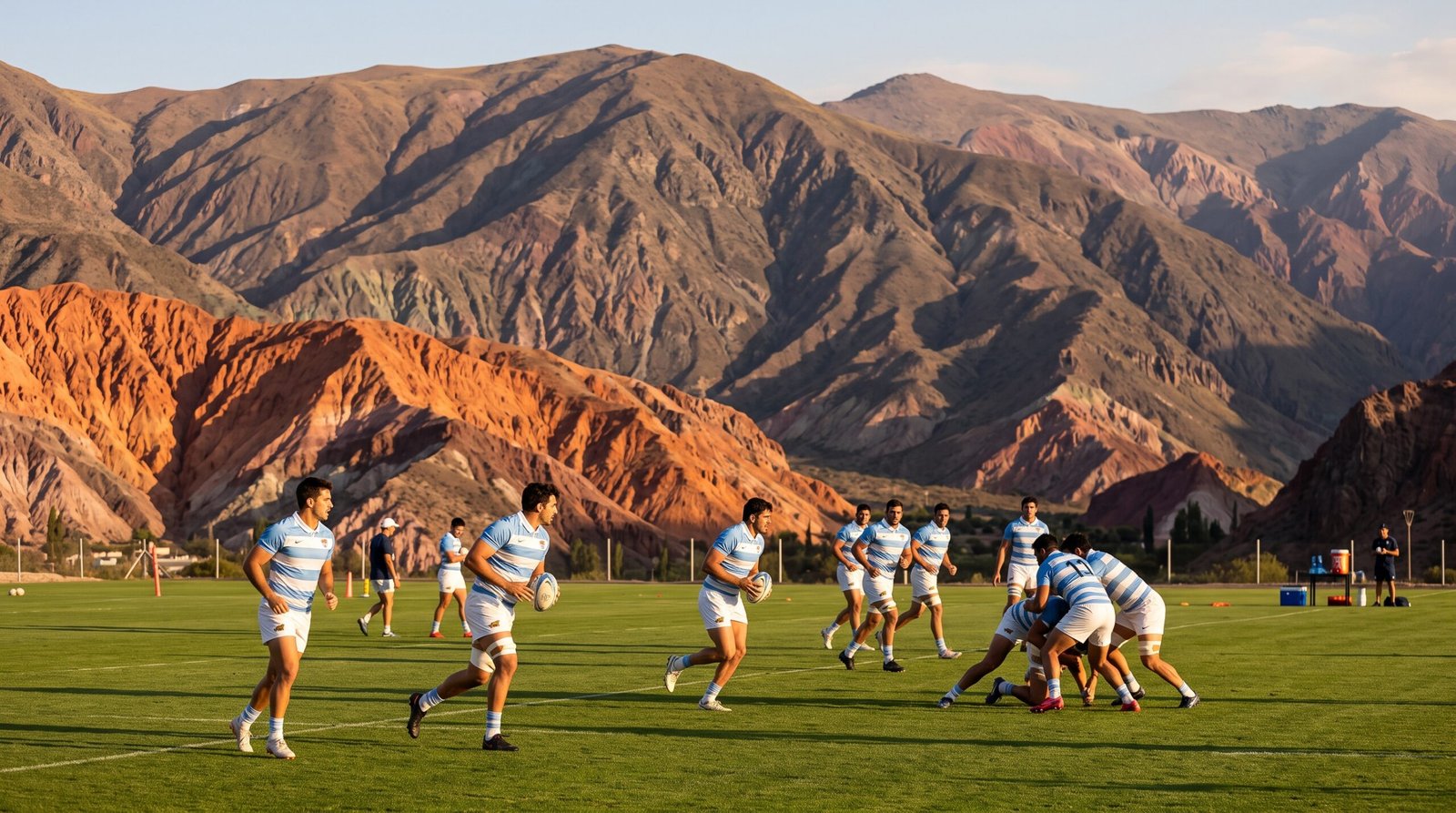
Los Pumas squad training in northern Argentina before the Australia tests in Jujuy and Mendoza 2026

Pablo Matera: The Loose Forward Who Rebuilt Los Pumas

Pablo Matera has played more Tests for Argentina than anyone in the country’s history, and at 33 he is still the man Los Pumas turn to when a series needs settling. In Mendoza this month, it was Matera’s try that put Argentina 28-21 up against Australia in the final quarter — the platform for a defiant 13-man hold that closed out the Wallabies series with a draw rather than a defeat.

Pablo Matera: the Argentina flanker leads Los Pumas onto the field
Pablo Matera training with Los Pumas ahead of the Wallabies series, August 2026.

Pablo Matera: Argentina’s Most Capped Player

Pablo Matera became Argentina’s most capped player of all time in 2025, passing a mark that took him more than a decade to build. He made his Los Pumas debut in 2013 against Chile as a 19-year-old flanker, and has barely left the back row since — across three Rugby World Cups and three different continents of club rugby.

Matera featured at the 2015 World Cup as Argentina reached the semi-finals and finished fourth, then again in 2019 as the side went out in the pool stage. By 2023, he was one of the senior figures in a Pumas squad that reached the semi-finals for the second time in his career, before beating England 26-23 in the bronze medal match — Argentina’s best World Cup finish since that 2015 run. Few players anywhere have carried a national side through three tournaments with such different outcomes and stayed the constant across all of them.

On 14 November 2020, Matera captained Los Pumas to their first-ever win over the All Blacks, a 25-15 upset that remains one of the defining results in Argentine rugby history. It came inside the pandemic-era bubble in Newcastle, Australia, with Matera at the head of a pack that simply refused to be moved.

The Try That Put Los Pumas Ahead in Mendoza

Six years on from that night in Newcastle, he is still the player Argentina’s forward pack is built around. His try in Mendoza against Australia was textbook Matera: close-range, hard-carried, and delivered exactly when his team needed the lead back. Argentina held it at 28-21 before two yellow cards — Rodrigo Cinti and Santiago Carreras — left Los Pumas defending with 13 men for the final ten minutes. Australia scored the penalty try that leveled the match, but the platform built in the previous 60 minutes was the reason Argentina had a lead worth defending at all.

Pablo Matera: A Career Built Across Three Continents

Pablo Matera’s club career reads like a tour of world rugby. He started at Leicester Tigers as a 20-year-old injury cover signing, captained the Jaguares through their Super Rugby years in Buenos Aires, spent two seasons at Stade Français in Paris, and took a short-term deal at the Crusaders in New Zealand before settling in Japan, where he has played for Honda Heat since 2022. Few forwards from any country have tested themselves against as many different rugby cultures, and it shows in how he reads a game — equally comfortable grinding out a forward battle or carrying the ball into space.

At 1.92m and 111kg, Matera remains Argentina’s benchmark loose forward heading toward the 2027 World Cup, and Felipe Contepomi’s side leaned on him again in this series against Australia. For a Pumas pack still searching for consistency across 80 minutes, his answer to that in Mendoza is a marker for what the team looks like at its best.

The Wallabies series was not a straightforward one for Los Pumas. Australia won the opener in Jujuy 27-21, and Argentina went to Mendoza needing a response rather than a formality. Matera’s performance there did not turn a losing series into a winning one, but it changed how it ends: a Pumas side that leaves the tour with a draw and a statement, rather than a series lost, and a clear answer to who Contepomi’s team is built around going forward.

For more on how the series against Australia unfolded, read our report on the draw in Mendoza and our account of Argentina’s rivalry with the All Blacks. For Matera’s full club and international record, see his profile on Wikipedia.


Similar Posts

  • Marcos Ayerza Leicester Tigers is a story of quiet dominance — thirteen years, over 250 appearances, no Argentine has matched it since.

    When Leicester Tigers signed a young loosehead prop from Buenos Aires in 2005, nobody quite knew what they were getting. By the time Marcos Ayerza retired in 2018, he had become the most decorated and longest-serving Argentine in the history of the English Premiership — a player so embedded in the Tigers’ identity that many Leicester fans simply forgot he wasn’t English. According to World Rugby, Argentina remain one of the sport’s most compelling stories. From Buenos Aires to Welford Road Ayerza was born in 1983 in Buenos Aires and came through the Argentine club rugby system before catching the attention of European scouts. At the time, Argentine props were not yet the global commodity they are today. The Pumas were still building their reputation, and the pathway from Argentine club rugby to the English Premiership was narrow and unforgiving. He arrived at Leicester with strong fundamentals — the Argentine scrum school is arguably the best in the world at developing technically correct props — but needed time to adapt to the physicality and pace of the Premiership. That adaptation period was brief. Within two seasons, he was a first-choice starter. The Leicester Years What made Ayerza exceptional was not individual brilliance but reliability. In a position where a single technical flaw can cost a team three points, Ayerza scrummaged with consistency that Leicester could build a game plan around. His understanding of the laws, his body positioning, and his ability to function under pressure in tight-game situations made him invaluable to coaches Martin Johnson, Richard Cockerill, and Matt O’Connor across different eras of Tigers rugby. He won the Premiership title with Leicester and was part of the squad during one of the club’s most successful periods in the competition’s modern history. He made over 250 appearances in all competitions for the Tigers — a number that represents extraordinary longevity for a prop in professional rugby. Off the pitch, Ayerza was known as a professional’s professional. No controversy, no transfer sagas, no public disputes with management. He arrived, trained hard, played hard, and went home. In an era of increasingly transient professional rugby careers, thirteen years at a single club is a statement of loyalty that very few players of any nationality can match. The numbers tell the story: Marcos Ayerza Leicester Tigers career spanned thirteen seasons and over 250 appearances, a record no Argentine has come close to matching in English rugby. The Argentine Dimension Ayerza earned over 60 caps for Argentina, becoming a key part of the Los Pumas scrum during a period when their set piece was establishing itself as one of the most feared in international rugby. The combination of his Leicester experience — training and playing against the best English props week in, week out — and the Argentine technical scrum tradition made him a uniquely complete player at international level. He was part of the Argentina squad that famously finished third at the 2007 Rugby World Cup in France, a tournament that changed how the world viewed Argentine rugby. That generation — Mario Ledesma, Rodrigo Roncero, Ayerza — built a scrum platform that the backs could exploit, and Los Pumas used it to dismantle France in the bronze medal match in front of 80,000 people in Paris….

  • The Argentina rugby eligibility rule is unique in world rugby: if you were not born in Argentina, you cannot play for Los Pumas — no exceptions, no heritage selections, no residency shortcuts.

    The Argentina rugby eligibility rule is simple, strict, and unique in world rugby: if you were not born in Argentina, you cannot play for Los Pumas — regardless of how long you have lived there, how Argentine your upbringing was, or how badly the team needs you. Every other major rugby nation operates a system that allows heritage selections, long-term residency qualifications, and — in some cases — players who simply could not get into their original country’s squad and decided to represent somewhere else instead. Argentina does not. The UAR’s born-in-Argentina policy is the most restrictive eligibility standard in international rugby, and it generates debate every time it costs the Pumas a player or a rival nation benefits from a player with Argentine roots. I have been following Argentine rugby for most of my life and played the game in Buenos Aires for thirteen years. My view on this rule is probably more nuanced than most: I think the UAR is right to hold the line, even when it hurts. What the Rule Actually Says The Argentina rugby eligibility rule requires Pumas players to have been born on Argentine soil. This goes beyond World Rugby’s eligibility regulations, which allow players to represent a nation through birth, parentage, grandparentage, or three consecutive years of residency. The UAR voluntarily applies a stricter standard internally — you can qualify for Argentina under World Rugby rules, but if you were not born in Argentina, the UAR will not select you. This is a policy decision, not a legal requirement. The UAR chose this position deliberately. The Case That Captures the Debate: Domingo Miotti Last week, Domingo Miotti…

Leave a Reply

Your email address will not be published. Required fields are marked *